
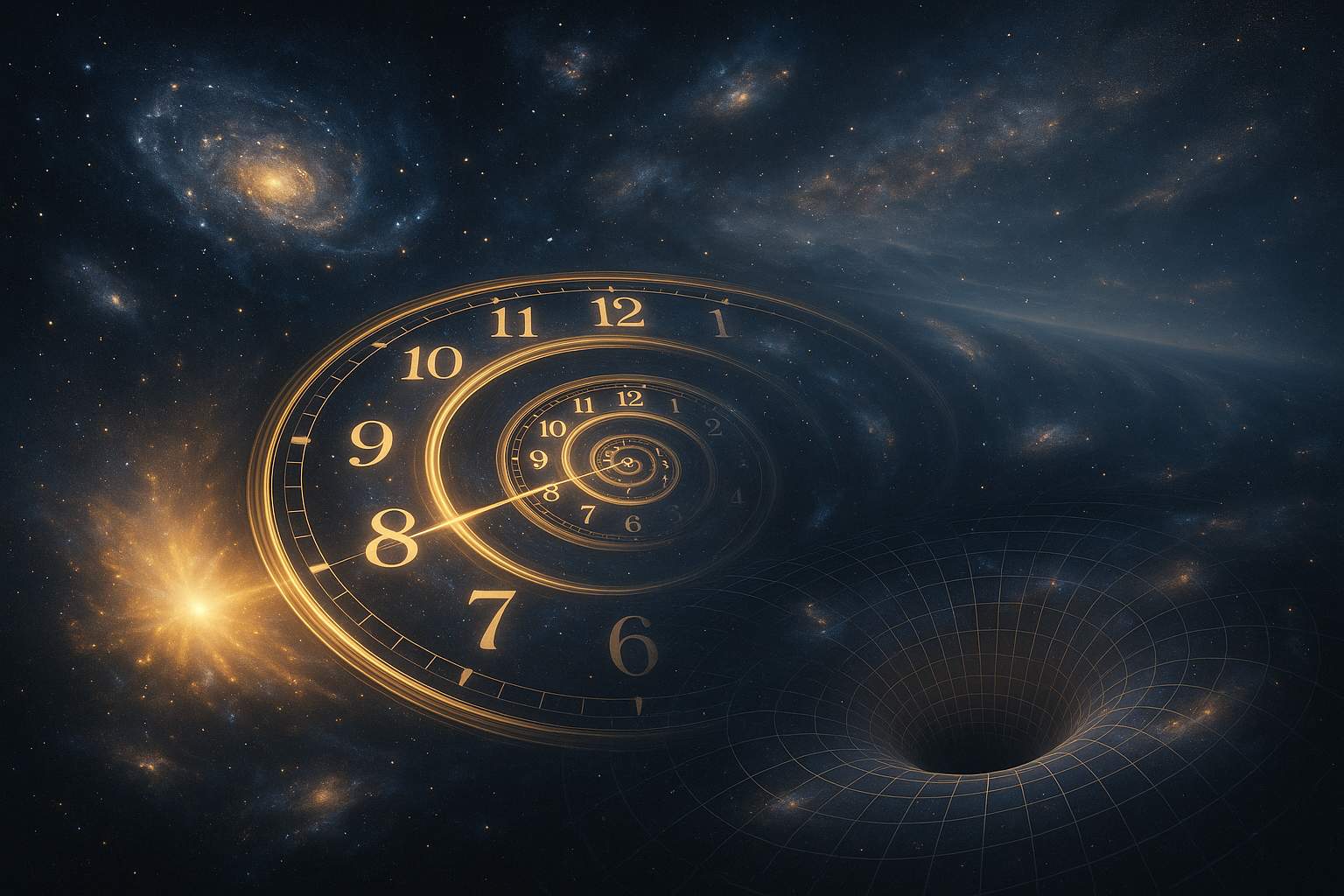
The Mystery of Time: Why the Universe Has a Past, Present & Future
In our previous article, we travelled back to the very beginning of everything — the Big Bang.
We saw how time itself was born in that moment, flowing outward like a river carrying galaxies, stars, planets, and eventually… us.
But what exactly is time?
Why does it only move forward?
And is time the same everywhere in the universe?
Today, let’s dive into one of the most fascinating cosmic mysteries: the nature of time — the clock of the universe.
1. Time Was Born with the Big Bang
Before the Big Bang, there was no space, no matter… and no time.
Time isn’t something outside the universe — it came into existence with the universe.
Think of time as the fourth dimension, woven together with the three dimensions of space.
Together, this forms what Einstein called spacetime.
Simple idea:
Just like you cannot separate length from width, you cannot separate space from time.
2. Why Does Time Only Move Forward?
Every day we wake up, live our lives, and move from past → present → future.
But why can’t we ever go back?
Scientists believe it’s because of something called entropy — the natural tendency of things to move from order to disorder.
A cup falls and breaks — but a broken cup never jumps back together.
Eggs crack — but don’t un-crack.
We grow older — and cannot grow younger.
Time flows forward because the universe is moving toward more disorder.
Simple picture:
Entropy is like a messy room. It’s easy for it to become messier, but hard to magically clean itself.
3. Time Moves Differently for Different People
This may sound strange, but time doesn’t tick at the same speed everywhere.
Einstein showed that:
Time slows down when you move very fast.
An astronaut traveling near the speed of light would return younger than people on Earth.
Time also slows down in strong gravity.
This means time runs a tiny bit slower on the surface of Earth than on the top of a mountain.
These effects are small in daily life, but huge in space travel.
Amazing fact:
GPS satellites must correct for time differences every day — otherwise our maps would be off by kilometers!
4. Is Time Travel Possible?
Science fiction loves time machines — but what does science say?
Time travel to the future is possible.
Using high speeds or strong gravity, you can slow down your personal time.
Time travel to the past is far more complicated.
It creates paradoxes, such as:
“If you go back and stop your grandparents from meeting… then how were you born to go back?”
Scientists propose wild ideas like wormholes — tunnels through spacetime — but we don’t know if they can truly exist.
Time travel remains a thrilling possibility, but for now, only in theory.
5. The Universe Has an Age — But What About Time Before Time?
We know the universe is 13.8 billion years old, but what existed before the Big Bang?
Some theories suggest:
Time did not exist — the Big Bang was the start of time.
The universe might be part of a cycle — Big Bang, Big Crunch, and then a new Big Bang.
Our universe might be one bubble in a multiverse, each with its own flow of time.
We still don’t have answers — but the questions themselves show how mysterious time truly is.
6. The Future of Time: How Will the Universe End?
If time began at the Big Bang, will it also end one day?
Here are the leading ideas:
The Big Freeze
The universe keeps expanding, stars burn out, and everything slowly becomes cold and dark.
The Big Crunch
Gravity pulls everything back together into a hot, dense point — reversing the Big Bang.
The Big Rip
Dark energy grows so strong that galaxies, stars, planets, and even atoms get torn apart.
Whatever happens, the flow of time will shape the universe’s final destiny.
Closing Thoughts: Time Lives Inside Us Too
We often think of time as something outside us — ticking on clocks or moving planets.
But time is also within us:
In every heartbeat
In every memory
In every sunrise and sunset
In every dream of tomorrow
The universe measures its age in billions of years.
We measure ours in decades, moments, and stories.
And yet — both are part of the same cosmic time.
The stars that light our sky were born long before humans existed.
But today, through curiosity and science, we finally understand their past — and maybe even their future.
So next time you check the time, remember: you are part of the universe’s grand clock, ticking since the moment of creation.
Coming Up Next…
In the next article, we’ll explore:
How scientists actually measure the age of the universe
How telescopes look back in time
And why looking at distant stars is like reading old cosmic letters
Until then — stay curious, stay inspired, and keep looking up.
With time and wonder,
Sha