
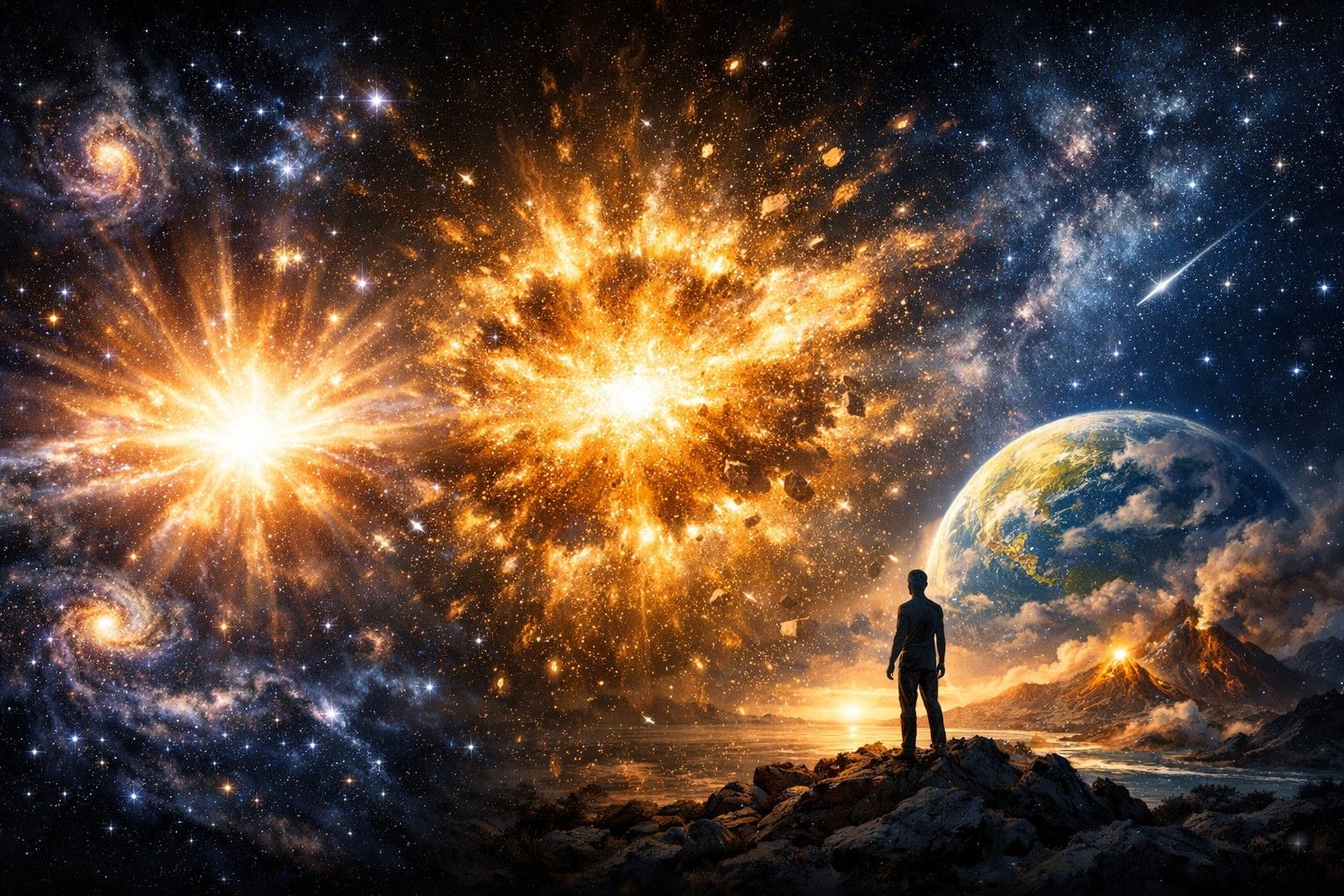
From Stardust to Life: How the Universe Created Us
In our previous article, we learned how scientists look back in time using light. We discovered that when we observe distant stars and galaxies, we are actually seeing the past. We learned how telescopes help us read the universe’s history.
Now, let us bring that history closer to home.
If the universe began with the Big Bang, and stars formed over billions of years, where do we fit into this story? How did lifeless particles turn into planets, oceans, trees, animals, and human beings?
To understand this, we must return to the stars.
The First Ingredients of the Universe
Right after the Big Bang, the universe was extremely hot. As it cooled, the first simple elements formed — mainly hydrogen and helium. These were the basic building blocks of everything.
But hydrogen and helium alone cannot form life. Life requires heavier elements like carbon, oxygen, nitrogen, iron, and calcium. So where did those come from?
They were made inside stars.
Stars: The Cosmic Factories
Stars are not just glowing balls of gas. Inside them, powerful nuclear reactions take place. These reactions fuse lighter elements into heavier ones.
For millions or billions of years, stars quietly manufacture the elements that later become planets and living things.
When very massive stars reach the end of their lives, they explode in gigantic events called supernovas. These explosions scatter newly formed elements across space.
Those elements drift through the universe, eventually gathering again under gravity to form new stars and new planetary systems.
Our solar system was born from such recycled stardust about 4.6 billion years ago.
The Birth of Earth
As the young Sun formed, dust and gas around it began clumping together. Over time, these clumps became planets. One of them was Earth.
At first, Earth was hot and violent, covered with volcanoes and molten rock. But gradually, it cooled. Water collected on its surface. The atmosphere formed.
Under the right conditions, simple molecules began to combine in more complex ways.
Somewhere in Earth’s early oceans, the first tiny life forms appeared.
From Simple Life to Complex Life
Life began very small — single-celled organisms that lived in the oceans. Over millions of years, through slow changes and evolution, life became more complex.
Plants, animals, forests, and eventually humans appeared.
All of this began from simple atoms created inside ancient stars.
The iron in your blood, the calcium in your bones, and the oxygen you breathe were forged long ago in stellar furnaces.
In a very real sense, we are made of stardust.
A Connected Universe
Understanding this changes how we see ourselves. We are not separate from the universe. We are not visitors in it.
We are part of it.
The same physical laws that govern galaxies also govern the atoms inside us. The same cosmic history that shaped distant stars shaped Earth and every living being.
The universe evolved — and through that evolution, it created beings capable of understanding it.
As Carl Sagan once said, we are a way for the cosmos to know itself.
To Wrap Up
From the Big Bang to the birth of stars, from exploding supernovas to the formation of Earth, the story of the universe is also our story.
It is a story of transformation — from energy to matter, from matter to stars, from stars to life.
The next time you look up at the night sky, remember: the light you see is ancient. And the atoms inside you are even older.
You are not just observing the universe.
You are a part of its ongoing journey.
With wonder,
Sha