
Looking Back in Time: How We Read the Universe’s History
In our previous article, we explored the mystery of time — how it was born with the universe, how it flows forward, and how it bends under speed and gravity. We learned that time is not just something measured by clocks; it is woven into the very fabric of the cosmos.
This naturally leads to an even more fascinating question: if the universe began billions of years ago, how do we know what happened long before humans existed?
The answer lies in something we encounter every day but rarely think deeply about — light.
Light: The Universe’s Messenger
Light does not travel instantly. It moves extremely fast, about 300,000 kilometers per second, yet even at this speed it takes time to cross the vast distances of space.
Light from the Sun takes about eight minutes to reach Earth. Light from the nearest star takes more than four years. Light from distant galaxies takes billions of years.
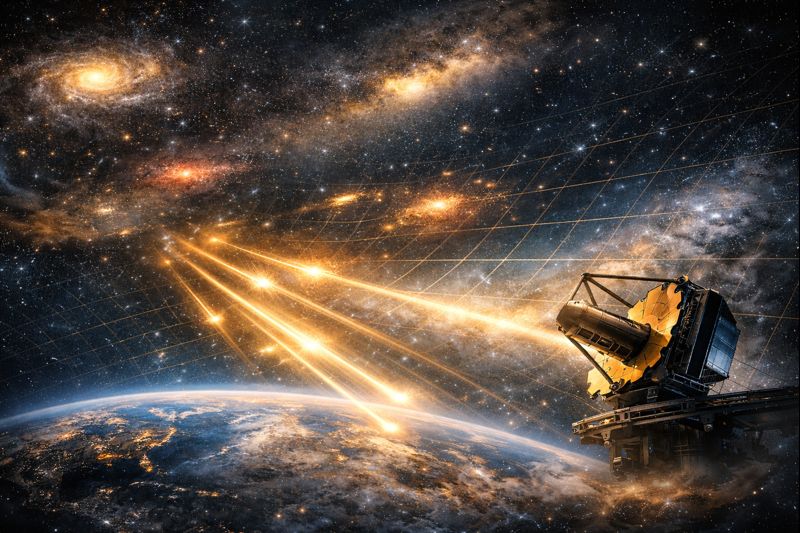
This means that when we look at the night sky, we are not seeing stars and galaxies as they are now. We are seeing them as they were long ago. In this sense, every telescope is a time machine.
Telescopes: Windows into the Past
Early humans studied the sky with their naked eyes. Today, we use powerful telescopes to see deeper into space and further back in time.
The Hubble Space Telescope revealed galaxies forming, colliding, and changing over billions of years. The James Webb Space Telescope goes even further by observing infrared light, allowing scientists to see through cosmic dust and study the first galaxies formed shortly after the Big Bang.
When scientists observe these ancient galaxies, they are reading pages from the universe’s earliest history.
How Do Scientists Measure the Age of the Universe?
Scientists calculate the age of the universe using several important clues.
One key clue is the expansion of the universe. Galaxies are moving away from one another, and by measuring how fast this expansion is happening, scientists can trace it back to a single beginning.
Another clue is the cosmic microwave background, a faint glow found everywhere in space. This glow is leftover heat from the Big Bang and acts like a baby photograph of the universe.
Scientists also study the oldest stars and how they evolve over time. All these methods agree on the same conclusion: the universe is about 13.8 billion years old.
Why Distant Galaxies Look Younger
When we observe distant galaxies, they often appear small, chaotic, and young. This is not because they are different from nearby galaxies, but because we are seeing them at an earlier stage in their development.
Just as old photographs show people as they once were, distant galaxies reveal the universe’s past.
Our Place in Cosmic History
Understanding the history of the universe gives us a new perspective on ourselves.
Earth is about 4.5 billion years old, and humans have existed for only a tiny fraction of cosmic time. Yet in this brief moment, we have learned how to read the universe’s story.
The atoms in our bodies were created inside ancient stars. The light reaching our eyes tonight may have started its journey before Earth even formed.
To Wrap Up
The universe does not hide its past. It shares its history through light. Every star, every galaxy, and every faint glow in space carries information from long ago.
By learning to read these messages, humans have transformed curiosity into knowledge and wonder into understanding.
So the next time you look up at the night sky, remember that you are not just looking at stars. You are looking into deep time itself.
With wonder,
Sha