
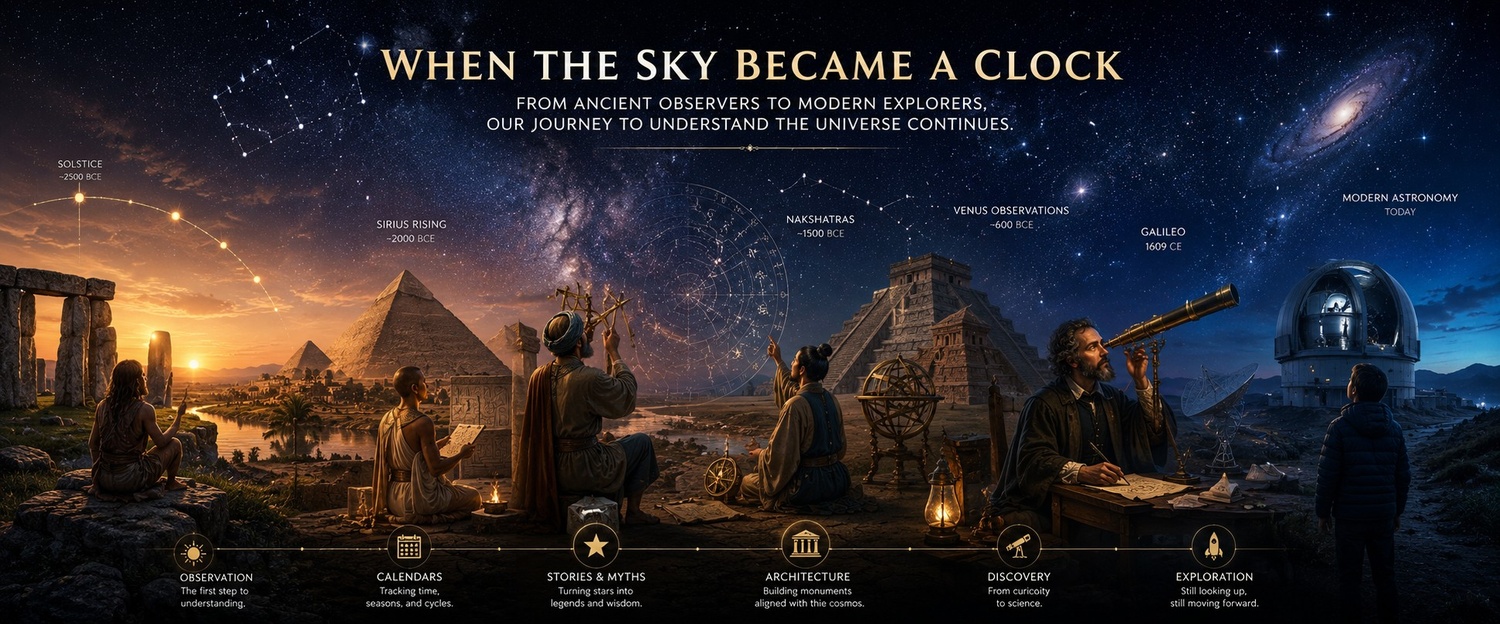
When the Sky Became a Clock: Humanity’s First Connection with the Stars
Long before telescopes, satellites, or modern science, humanity looked upward with wonder. The night sky was more than beauty—it was a guide, a mystery, and a map of survival. The stars became humanity’s first teachers.
The Ancient Skywatchers
Thousands of years ago, early civilizations noticed patterns in the heavens. Certain stars appeared during specific seasons. The Moon changed shape in a predictable cycle. The Sun rose and set with remarkable precision.
These observations changed human life forever.
Farmers learned when to plant crops by watching the skies. Sailors navigated oceans using constellations. Priests and scholars created calendars based on celestial movement. Across Egypt, Mesopotamia, India, China, and the Americas, the cosmos shaped culture and civilization.
The sky became humanity’s first clock.
Stories Written in Stars
Ancient people did not see random dots in the night. They saw heroes, animals, gods, and legends. Constellations became a way to preserve stories and pass knowledge through generations.
The Greeks imagined Orion the hunter.
Indian astronomy described the Nakshatras.
Chinese astronomers mapped dragon-like celestial patterns.
The Maya tracked Venus with astonishing precision.
Though separated by oceans and centuries, humans everywhere shared one instinct: to understand the heavens.
Monuments Aligned with the Cosmos
Many ancient structures reveal humanity’s deep connection with the sky. The pyramids of Egypt align with stars. Stonehenge marks solar movements. Ancient temples across India and South America were designed around celestial events.
Without modern tools, early astronomers achieved extraordinary accuracy through observation and patience.
The universe inspired architecture, religion, mathematics, and philosophy long before modern science existed.
From Myth to Science
As centuries passed, curiosity evolved into scientific exploration. Thinkers like Copernicus, Galileo, and Kepler challenged old beliefs and revealed that Earth was not the center of the universe.
The invention of the telescope opened a new era. Humanity saw moons orbiting Jupiter, rings around Saturn, and galaxies beyond imagination.
The night sky transformed from mythology into a cosmic laboratory.
The Same Wonder Still Lives
Today, we use advanced telescopes to study black holes, distant galaxies, and the origins of the universe itself. Yet despite all our technology, the feeling remains the same as it was for our ancestors standing beneath ancient skies Wonder.
Every child who looks up at the stars continues a tradition older than recorded history. The universe still calls us to ask questions, seek meaning, and dream beyond horizons.
And perhaps that is humanity’s greatest gift— not simply the ability to survive, but the courage to wonder.